
The resignation of yet another British Prime Minister is not only a political story. It is also a behavioural one.
Brexit has become one of the most powerful modern case studies in how people make high-stakes decisions under emotion, uncertainty and identity pressure. Ten years after the referendum, the question is no longer simply whether Britain should have left the European Union. The more useful question is this: what behavioural forces shaped the decision, and why do so many people now appear to regret it?
The Brexit vote was never only about trade agreements, borders, courts or sovereignty. Those were the rational containers. Beneath them sat something far more human: identity, fear, frustration, belonging and perceived loss.
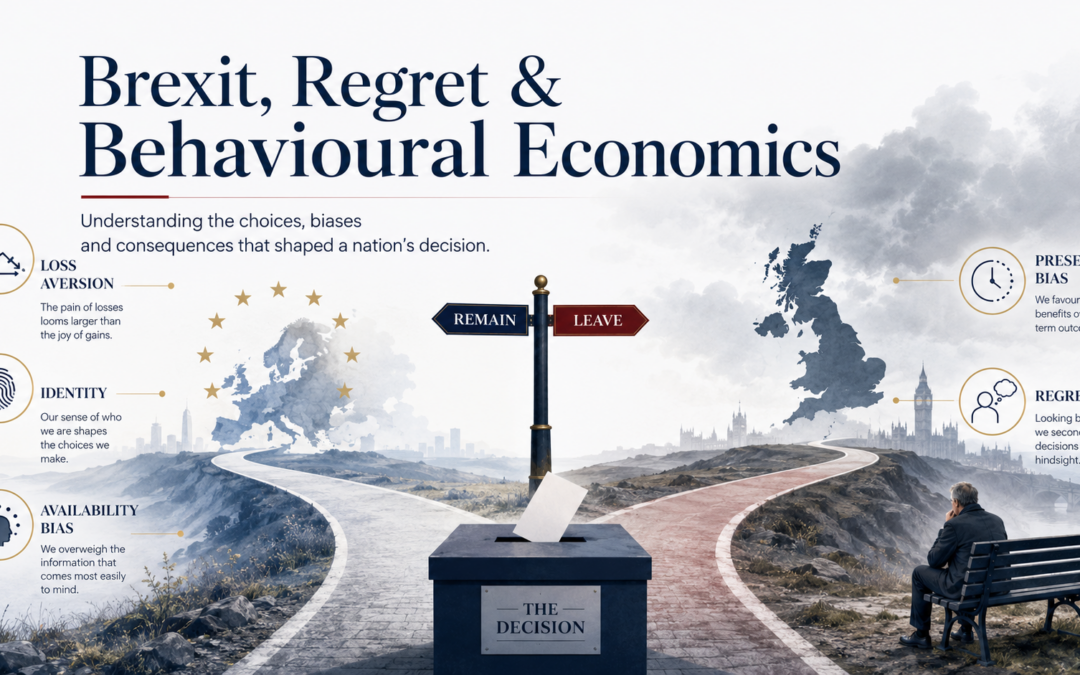
Loss Aversion
One of the most important behavioural economics principles at play was loss aversion. People tend to feel the pain of loss more strongly than the pleasure of equivalent gain. For many voters, the Leave campaign successfully framed EU membership as a loss: loss of control, loss of borders, loss of national identity, loss of money, loss of influence. “Take back control” was not just a slogan. It was a behavioural trigger. It gave people a simple emotional frame for a complex political and economic decision.
Availability Bias
The second principle was availability bias. People judge the importance of an issue by how easily examples come to mind. Immigration, bureaucracy and distant EU institutions were made highly visible and emotionally available. The quieter benefits of EU membership — trade flow, regulatory alignment, labour mobility, research collaboration and geopolitical leverage — were harder to feel in daily life. In behavioural terms, the tangible grievance beat the invisible benefit.
Present Bias
Then came present bias. The referendum offered an immediate emotional reward: a sense of agency, protest and release. The costs were delayed, technical and uncertain. Humans are notoriously poor at weighing delayed consequences against immediate psychological satisfaction. “This will feel better now” often beats “this may cost us later”.
Identity-protective cognition
Brexit also revealed the power of identity-protective cognition. Once a political choice becomes attached to identity, people do not process information neutrally. They defend the group, the tribe and the story. The question shifts from “What is true?” to “What does someone like me believe?” That makes public debate more emotionally charged and less evidence-led. Facts become ammunition rather than illumination.
But perhaps the most important lesson now lies in the psychology of regret.
Expectation Gap
Regret often emerges when the imagined future sold to us does not match the lived experience that follows. Behavioural economists would call this an expectation gap. Before Brexit, many voters were invited to imagine greater control, stronger borders, more money for public services, better trade deals and renewed national confidence. After Brexit, many experienced something more complicated: friction, uncertainty, lower trust in political leadership and a sense that the promised upside had not materialised.
That gap matters. In business, culture and leadership, disappointment is rarely caused by outcomes alone. It is caused by the distance between what people expected and what they actually experienced.
Choice-Supportive bias
There is also choice-supportive bias, where people initially defend decisions they have made, even when evidence becomes uncomfortable. This helps explain why regret can take time to surface. People do not like admitting they were misled, mistaken or emotionally over-invested. But when daily evidence keeps contradicting the original promise, the story begins to crack.
The current British political instability is part of that cracking. Brexit did not merely change Britain’s relationship with Europe. It changed the country’s relationship with trust. Trust in leaders. Trust in institutions. Trust in expertise. Trust in whether anyone really knows what they are doing.
For organisations, the lesson is clear.
People do not make change decisions based only on strategy decks, financial models or rational arguments. They respond to stories, identity, perceived fairness, emotional salience and the credibility of the people asking them to change.
If leaders frame change around what people are losing, they must be honest about what is being gained. If they create expectations, they must be able to deliver against them. If they ask people to “take back control”, they had better be clear about what control actually means in operational terms.
Brexit reminds us that behaviour does not end at the moment of decision. The real test comes afterwards, when people live with the consequences.
That is where regret is born.
And that is also where better leadership begins.

When Fear Looks for a Target
South Africa knows this feeling. The WhatsApp warnings start first. Which roads to avoid. Which shops are closing early. Which areas might flare up. Whether staff will be able to get to work. Whether this will be “another July 2021”. Reports of possible unrest linked...

Cutting Through the Noise: The Ridgeline Approach to Leadership Communication
Everyone knows the sounds of their incoming communication. Emails landing in the inbox, chat pings online, and WhatsApp beeps all contribute to cognitive overload. The traditional approach to leadership communication often feels like shouting into a hurricane. Louder...

A Laugh in the Spotlight: Some crazy moments as an MC
There’s a certain art to being an MC—balancing professionalism with personality, steering the programme while keeping the mood light. Over the years, I’ve found myself in all sorts of hilarious situations at the podium, but a few experiences stand out as my all-time...

Beyond the Bush Lodge: Why Your Next Executive Offsite is Performance Infrastructure, not a Perk
In the South African business landscape, we are currently navigating a uniquely noisy macro picture. From the accelerating shift toward AI-integrated workflows to the stop-start nature of global trade and local economic pressures, the external environment is...

Leading Through Anxiety: 5 Moves to Lift Morale (Without Sugar-Coating Reality)
South African teams are currently navigating a noisy macro picture. From headlines about AI replacing jobs to public cost-cutting and stop-start global trade, the external environment is amplifying anxiety on the office floor. Research published in Harvard Business...

Purpose Sets the North Star; Strategy Redraws the Route
Leaders often find themselves at a crossroads: should they meticulously refine their strategy, or should they take a step back to clarify their fundamental purpose? At Ridgeline Consulting, we firmly believe that purpose sets the non-negotiables; strategy is the route...

Preserving Your Company’s Unique Flavour: The Art of Cordialism
Companies often find themselves in a peculiar predicament: as they expand, merge, or undergo significant transformations, they risk losing their distinctive essence—their unique 'flavour'. This phenomenon, which Ridgeline Consulting aptly terms 'Cordialism', draws a...

From Quiet Quitting to Committed Teams: A Leader’s Guide to Building a Culture of Control and Voice
Quiet quitting is a design problem, not a motivation problem. Learn how to build a culture of control, voice, and clarity that fosters commitment and drives performance. A practical playbook for leaders. When your best people start doing the bare minimum, it’s easy to...

From Perks to Performance: A Behavioural Strategist’s Guide to Building a Magnetic Culture
In the modern workplace, a common misconception is that superficial perks are the primary drivers of employee engagement and retention. While catered lunches and office ping-pong tables may offer temporary enjoyment, they are ultimately fleeting and fail to address...

Elevating Sales Performance: A Behavioural Strategy for Sustainable Growth
High-performing sales cultures don’t push harder—they design smarter. In today's dynamic marketplace, the traditional 'hard sell' is becoming increasingly obsolete. High-performing sales organisations are not simply pushing harder; they are designing smarter. This...