

Leaders often find themselves at a crossroads: should they meticulously refine their strategy, or should they take a step back to clarify their fundamental purpose? At Ridgeline Consulting, we firmly believe that purpose sets the non-negotiables; strategy is the route you keep redrawing. When the landscape inevitably shifts, it’s your workplace culture that transforms that purpose into daily decisions, behaviours, and necessary trade-offs. This is precisely why our behavioural strategy approach begins with understanding your organisation’s “why” and then meticulously designs the social systems—the rituals, language, incentives, and leadership habits—that bring it to life.
Recent insights from Entrepreneur echo this sentiment, highlighting that while strategy can (and should) evolve, purpose must remain steadfast. The author eloquently describes purpose as the unwavering constant that provides essential fuel when plans falter, cultivates empathy for a deeper understanding of customers, and offers clarity when choices become muddled. These three critical functions directly correlate with how a robust culture performs under pressure.
Fuel When the Plan Breaks
Every organisation eventually encounters moments where the data suggests caution, but the mission demands action. Consider a financial services client in South Africa who experienced initiative sprawl during a period of market instability. By re-anchoring on a clear, shared purpose, their leaders gained the conviction to halt three appealing but ultimately misaligned projects and instead to double down on two initiatives that genuinely served their members best. Within ninety days, decision cycles accelerated, and employee sentiment improved significantly, with the Employee Net Promoter Score rising by nine points. This remarkable shift occurred because the organisational culture made these crucial trade-offs transparent and understandable.
This is the essence of behavioural strategy: codifying your intent so that your team knows precisely what to do when the established playbook doesn’t cover the unique challenges they face. The Entrepreneur piece aptly calls this the “fuel” that sustains progress when circumstances become difficult, a phenomenon we witness firsthand every week.
Empathy That Sharpens Value
Culture can either restrict your perspective, leading to an insular “we know best” mentality, or it can broaden your horizons, fostering a “we learn from the edges” approach. A healthcare group we partnered with successfully embedded their purpose into frontline rituals. For instance, micro-huddles would commence with a patient story directly linked to their core “why we exist”. This subtle behavioural nudge profoundly altered what leaders prioritised: while process metrics remained important, human outcomes became the central organising principle. As a result, complaint resolution times decreased, and first-contact resolution improved, because teams were trained and empowered to see the individual before the process. The Entrepreneur article reinforces this, arguing that purpose guides you to ask the right questions and understand the personas you might otherwise overlook.
Clarity for Hard Choices
Perhaps the most insidious cultural pattern isn’t overt conflict, but rather ambiguity. A fintech client in the UK and Nordics faced a compelling integration opportunity that promised accelerated market share. However, it directly conflicted with their core promise of data transparency. Because their purpose was explicit and consistently reinforced, they confidently declined the deal, redirecting investment into features that tangibly enhanced customer transparency. While revenue didn’t immediately skyrocket, customer churn stabilised, and their referral rate steadily increased quarter-on-quarter. Clarity doesn’t simplify decisions; it ensures they are consistent. This perfectly illustrates the “purpose as decision filter” dynamic highlighted in Entrepreneur: when options blur, purpose provides unwavering direction.
What This Means for Leaders
So, what are the practical implications for leaders planning their next off-site, whether in Johannesburg, Dubai, London, or any location where your teams operate across Africa, the UAE, the UK, the Nordics, or Western Europe?
- Start with purpose, not platitudes. Articulate it using strong verbs, not generic slogans. If reading it aloud doesn’t clarify a necessary trade-off, it’s not yet complete.
- Translate into behaviours. Identify three key leadership habits that will visibly embody this purpose this quarter. Which existing incentives might you need to re-evaluate or pause because they inadvertently reward misaligned behaviours?
- Design the culture moments. Onboarding processes, daily stand-ups, retrospectives, and performance reviews—each presents a valuable opportunity to embed your organisation’s “why” into the very fabric of how work is accomplished.
- Set a 90-day cadence. Your strategy will undoubtedly evolve; your fundamental purpose should not. Re-examine your strategic route every quarter, always aligning it with that unwavering North Star.
At Ridgeline, we often employ the metaphor of adventure: the outcome of any truly meaningful endeavour is inherently uncertain, and the terrain rarely matches the map’s promises. Purpose is your North Star; behavioural strategy is how you choose your path, place your feet deliberately, and journey together when the gradient becomes steep. Align these two elements, and workplace culture transcends being a mere buzzword, transforming into your most reliable and powerful performance system.
Ready to align your purpose, culture, and strategy? Book Erik to facilitate your next strategy off-site or leadership sprint – and let’s transform your “why” into the way your business truly operates.

When Fear Looks for a Target
South Africa knows this feeling. The WhatsApp warnings start first. Which roads to avoid. Which shops are closing early. Which areas might flare up. Whether staff will be able to get to work. Whether this will be “another July 2021”. Reports of possible unrest linked...
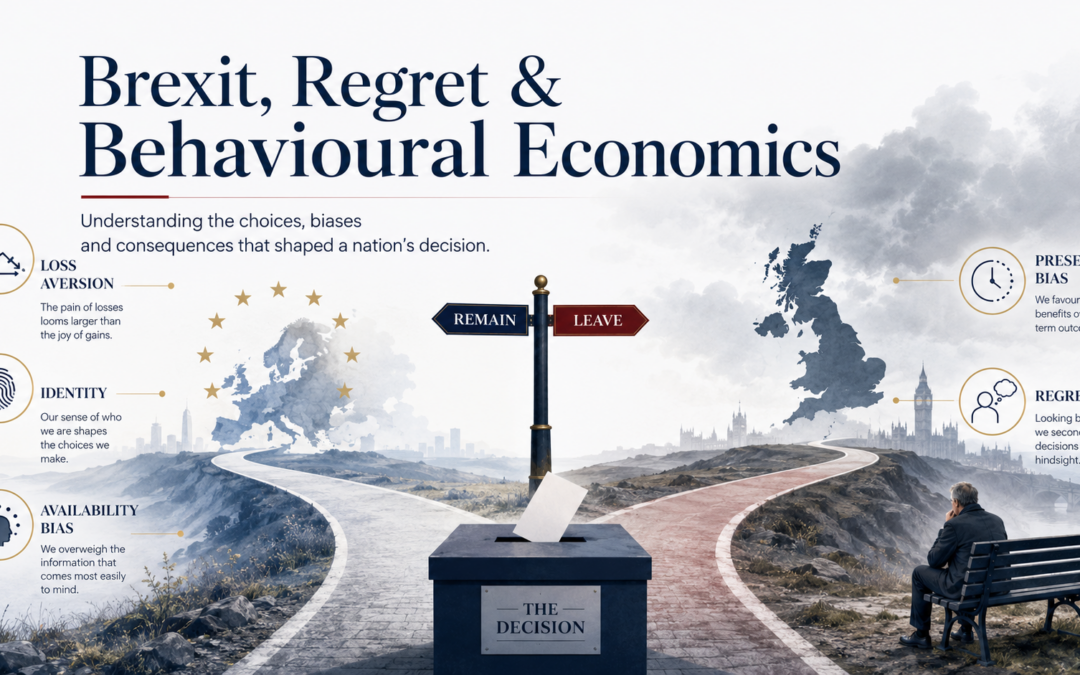
Brexit, Regret and the Behavioural Economics of Bad Decisions
The resignation of yet another British Prime Minister is not only a political story. It is also a behavioural one. Brexit has become one of the most powerful modern case studies in how people make high-stakes decisions under emotion, uncertainty and identity pressure....

Cutting Through the Noise: The Ridgeline Approach to Leadership Communication
Everyone knows the sounds of their incoming communication. Emails landing in the inbox, chat pings online, and WhatsApp beeps all contribute to cognitive overload. The traditional approach to leadership communication often feels like shouting into a hurricane. Louder...

A Laugh in the Spotlight: Some crazy moments as an MC
There’s a certain art to being an MC—balancing professionalism with personality, steering the programme while keeping the mood light. Over the years, I’ve found myself in all sorts of hilarious situations at the podium, but a few experiences stand out as my all-time...

Beyond the Bush Lodge: Why Your Next Executive Offsite is Performance Infrastructure, not a Perk
In the South African business landscape, we are currently navigating a uniquely noisy macro picture. From the accelerating shift toward AI-integrated workflows to the stop-start nature of global trade and local economic pressures, the external environment is...

Leading Through Anxiety: 5 Moves to Lift Morale (Without Sugar-Coating Reality)
South African teams are currently navigating a noisy macro picture. From headlines about AI replacing jobs to public cost-cutting and stop-start global trade, the external environment is amplifying anxiety on the office floor. Research published in Harvard Business...

Preserving Your Company’s Unique Flavour: The Art of Cordialism
Companies often find themselves in a peculiar predicament: as they expand, merge, or undergo significant transformations, they risk losing their distinctive essence—their unique 'flavour'. This phenomenon, which Ridgeline Consulting aptly terms 'Cordialism', draws a...

From Quiet Quitting to Committed Teams: A Leader’s Guide to Building a Culture of Control and Voice
Quiet quitting is a design problem, not a motivation problem. Learn how to build a culture of control, voice, and clarity that fosters commitment and drives performance. A practical playbook for leaders. When your best people start doing the bare minimum, it’s easy to...

From Perks to Performance: A Behavioural Strategist’s Guide to Building a Magnetic Culture
In the modern workplace, a common misconception is that superficial perks are the primary drivers of employee engagement and retention. While catered lunches and office ping-pong tables may offer temporary enjoyment, they are ultimately fleeting and fail to address...

Elevating Sales Performance: A Behavioural Strategy for Sustainable Growth
High-performing sales cultures don’t push harder—they design smarter. In today's dynamic marketplace, the traditional 'hard sell' is becoming increasingly obsolete. High-performing sales organisations are not simply pushing harder; they are designing smarter. This...