

High-performing sales cultures don’t push harder—they design smarter. In today’s dynamic marketplace, the traditional ‘hard sell’ is becoming increasingly obsolete. High-performing sales organisations are not simply pushing harder; they are designing smarter. This shift is rooted in a profound understanding of decision psychology and the subtle yet powerful influence of cognitive bias in decision-making. By embracing a sophisticated behavioural strategy for sales, we can empower our teams to confidently facilitate customer decisions, optimise their efforts, and achieve unprecedented levels of sales enablement without resorting to aggressive tactics.
At its core, this approach recognises that human decisions are rarely purely rational. Instead, they are shaped by a myriad of psychological factors, heuristics, and biases. By understanding these underlying mechanisms, sales professionals can guide prospects more effectively, building trust and fostering genuine partnerships. Let’s explore how integrating behavioural insights can transform your sales playbook.
1. The Power of the Micro-Deadline: Accelerating Engagement with Value
The initial follow-up often dictates the trajectory of a deal. Rather than a generic ‘checking in’ email, consider implementing a 24-hour micro-deadline for the first response. This isn’t about creating artificial urgency; it’s about leveraging a behavioural nudge to ensure value delivery. Within this timeframe, sales teams are encouraged to provide a tailored insight, a mini-diagnostic, or a highly relevant case study. By embedding this as a default task within your CRM, you create a system that automatically triggers this crucial step. This strategic application of a micro-deadline ensures prompt, value-driven engagement, subtly influencing the prospect’s perception of your responsiveness and expertise.
2. Architecting Choice: Guiding Decisions with Clarity
Presenting proposals can often overwhelm prospects, leading to analysis paralysis. Here, the principles of decision psychology become invaluable. Instead of a single, take-it-or-leave-it option, or a confusing array of choices, structure your proposals using ‘choice architecture’. Offer three distinct options – typically ‘good’, ‘better’, and ‘best’ – with a clear recommendation for the middle tier. Crucially, articulate the trade-offs associated with each. Research consistently shows that individuals tend to avoid extremes, making the middle option feel like a safe and optimal choice. A concise, visual comparison matrix further simplifies this process, making the decision feel manageable and empowering for the client.
3. Beyond Logos: The Impact of Specific Social Proof
While logos lend credibility, truly impactful social proof goes deeper. Generic endorsements often fall flat because they lack specificity and relevance. To genuinely build trust and mitigate cognitive bias in decision-making, sales professionals should focus on highly comparable and specific examples. Instead of merely stating a client’s name, quantify the impact: “Reduced onboarding time by 32% for a South African fintech with 200,000 users.” Even more compelling is to include the ‘before and after’ scenario, detailing the specific behaviours or strategies that led to the positive outcome. This level of detail resonates far more powerfully, allowing prospects to envision similar success within their own context.
4. Pre-Mortems: Uncovering Blind Spots Before They Derail Success
Before embarking on major pitches or strategic initiatives, conduct a ‘pre-mortem’. This powerful technique, rooted in decision psychology, involves imagining that the initiative has failed six months down the line and then asking, “Why did we lose?” This exercise encourages teams to proactively identify potential pitfalls, challenge optimistic biases, and refine their differentiators. By anticipating obstacles and developing contingency plans, you significantly enhance your chances of success, transforming potential weaknesses into strategic advantages. It’s a proactive measure that sharpens your strategy and strengthens your resolve.
5. Momentum with Respect: Sustaining Engagement Ethically
Maintaining momentum in a sales cycle is critical, but it must be done with respect for the client’s autonomy. A highly effective behavioural strategy for sales involves establishing a “next step by default”. This means that every meeting concludes with a calendar hold for the subsequent checkpoint. This approach preserves the cadence of engagement without exerting undue pressure. It subtly communicates commitment and progress, yet crucially, it leaves the agency with the client. They retain the power to reschedule if necessary, fostering a sense of control and partnership rather than obligation.
6. The Expedition Mindset: Sustainable Cadence Over Brute Force
Sales, much like scaling a formidable peak, are not a sprint; it’s an expedition. Sustainable success comes from a steady cadence, strategic checkpoints, and sound judgment, not brute force. The most effective sales leaders embody the ‘guide energy’: calm, prepared, and singularly focused on achieving positive outcomes. This mindset is integral to effective sales enablement, fostering a culture where teams are equipped to navigate complex sales journeys with resilience and foresight. It’s about working smarter, not just harder, and understanding that consistent, thoughtful effort yields far greater returns than sporadic bursts of intensity.
Conclusion: The Future of Sales is Behavioural
By integrating a sophisticated behavioural sales strategy, organisations can move beyond outdated methodologies and cultivate a sales culture that is both highly effective and deeply ethical. This approach, grounded in decision psychology and an awareness of cognitive bias in decision-making, not only accelerates decisions and protects valuable client relationships but also elevates the entire sales profession. It’s time to upgrade your sales playbook with behavioural design that drives sustainable growth and empowers your team to truly excel. Embrace the behavioural edge, and watch your sales performance reach new summits.

When Fear Looks for a Target
South Africa knows this feeling. The WhatsApp warnings start first. Which roads to avoid. Which shops are closing early. Which areas might flare up. Whether staff will be able to get to work. Whether this will be “another July 2021”. Reports of possible unrest linked...
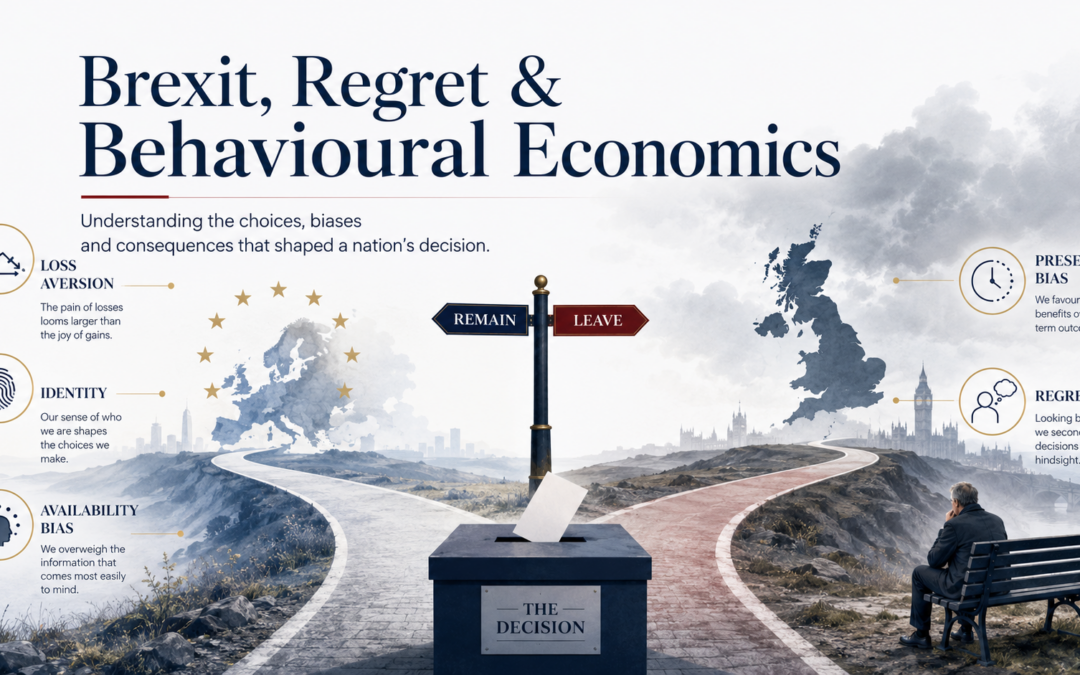
Brexit, Regret and the Behavioural Economics of Bad Decisions
The resignation of yet another British Prime Minister is not only a political story. It is also a behavioural one. Brexit has become one of the most powerful modern case studies in how people make high-stakes decisions under emotion, uncertainty and identity pressure....

Cutting Through the Noise: The Ridgeline Approach to Leadership Communication
Everyone knows the sounds of their incoming communication. Emails landing in the inbox, chat pings online, and WhatsApp beeps all contribute to cognitive overload. The traditional approach to leadership communication often feels like shouting into a hurricane. Louder...

A Laugh in the Spotlight: Some crazy moments as an MC
There’s a certain art to being an MC—balancing professionalism with personality, steering the programme while keeping the mood light. Over the years, I’ve found myself in all sorts of hilarious situations at the podium, but a few experiences stand out as my all-time...

Beyond the Bush Lodge: Why Your Next Executive Offsite is Performance Infrastructure, not a Perk
In the South African business landscape, we are currently navigating a uniquely noisy macro picture. From the accelerating shift toward AI-integrated workflows to the stop-start nature of global trade and local economic pressures, the external environment is...

Leading Through Anxiety: 5 Moves to Lift Morale (Without Sugar-Coating Reality)
South African teams are currently navigating a noisy macro picture. From headlines about AI replacing jobs to public cost-cutting and stop-start global trade, the external environment is amplifying anxiety on the office floor. Research published in Harvard Business...

Purpose Sets the North Star; Strategy Redraws the Route
Leaders often find themselves at a crossroads: should they meticulously refine their strategy, or should they take a step back to clarify their fundamental purpose? At Ridgeline Consulting, we firmly believe that purpose sets the non-negotiables; strategy is the route...

Preserving Your Company’s Unique Flavour: The Art of Cordialism
Companies often find themselves in a peculiar predicament: as they expand, merge, or undergo significant transformations, they risk losing their distinctive essence—their unique 'flavour'. This phenomenon, which Ridgeline Consulting aptly terms 'Cordialism', draws a...

From Quiet Quitting to Committed Teams: A Leader’s Guide to Building a Culture of Control and Voice
Quiet quitting is a design problem, not a motivation problem. Learn how to build a culture of control, voice, and clarity that fosters commitment and drives performance. A practical playbook for leaders. When your best people start doing the bare minimum, it’s easy to...

From Perks to Performance: A Behavioural Strategist’s Guide to Building a Magnetic Culture
In the modern workplace, a common misconception is that superficial perks are the primary drivers of employee engagement and retention. While catered lunches and office ping-pong tables may offer temporary enjoyment, they are ultimately fleeting and fail to address...